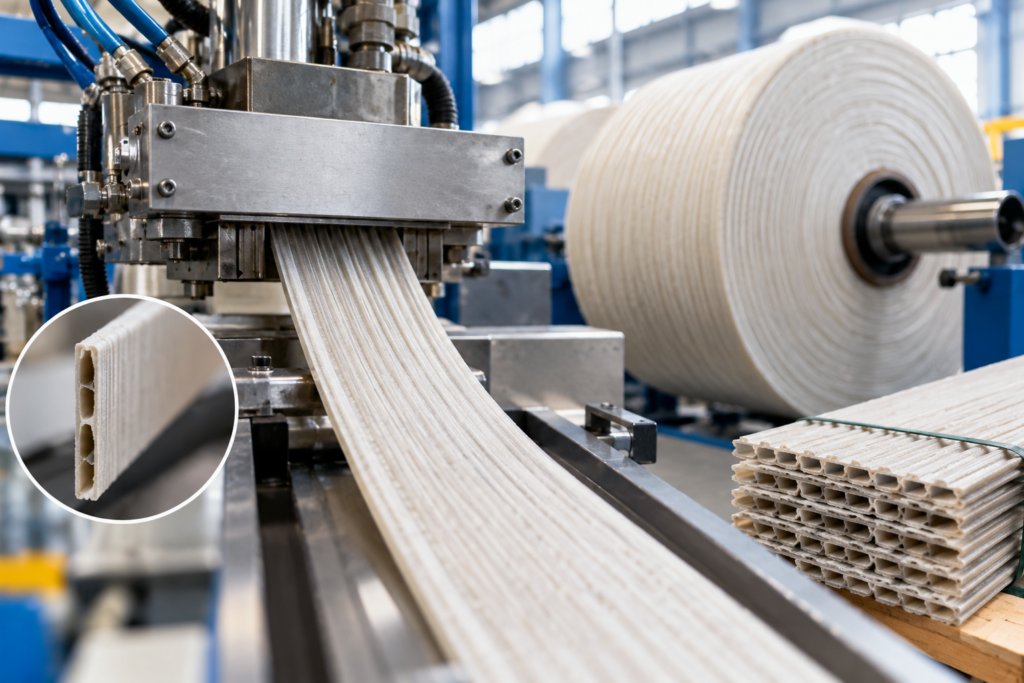
Tree shelters are widely used in reforestation, afforestation, and landscape restoration projects to protect young trees from wind, wildlife, and environmental stress during their critical growth phase. However, conventional plastic shelters often need to be collected and removed after use, creating significant labour costs. When left behind, they can contribute to long-term plastic accumulation in the environment.
while maintaining its mechanical performance and dimensional stability throughout use.
combining physical protection with natural browsing resistance.
improving processability and enabling high production speeds on standard industrial equipment.
Remy Jongboom explains why Caleyda®, produced from organic residual streams, is an excellent material choice for making controlled-release fertilizer coatings both biobased and biodegradable. He highlights why controlled- release Fertilizers need Caleyda®.
A new, circular chain — powered by microbes instead of oil wells.
We start with organic residual and side streams — resources that don’t compete with the food supply.
Natural mixed-culture microbes feed on the streams and produce PHA, stored inside their cells as PHA-X®.
The biopolymer is gently extracted from the biomass through the Caleyda® Extraction Process.
After use, Caleyda® is recycled mechanically or biologically — biodegrading without persistent microplastics.
Film, sheet and fibre extrusion on standard lines.
Filament and pellet printing with standard settings.
Rigid parts on standard injection moulding equipment.
Water-based coatings and binders for paper and board.
Melt-spun fibres for textiles, twine and nets.
Trays and cups from extruded sheet.
We let nature do the work.
During our PHAenix process, naturally occurring microbes produce a biopolymer (PHA) from organic residual streams. PHA is then used as the base for Caleyda®.
Unlike traditional plastics, this process uses no fossil resources, no genetic modification, and no harmful additives.
Caleyda® biodegrades in soil, fresh water and marine environments, as well as in industrial and home composting — without leaving persistent microplastics. Certificates follow as they are obtained.
Caleyda® is processed on standard equipment: extrusion, injection moulding, 3D printing and water-based dispersions. See our applications for examples, or contact us to discuss yours.
Our specialist is happy to talk about your process, your requirements and what this application can do for you. Call or send an e-mail.